Height, Power, Load & Access
Key specs to check before renting or buying industrial space.
When you view an industrial unit in Singapore, numbers like “8m clear height”, “20 kN/m² floor loading”, “up to 3‑phase 150A power” or “40-footer accessible” are often thrown around. These technical specifications directly affect what trades can operate there, how efficient your operations will be, and how easy it is to attract future tenants.
Clear Height: How Much Vertical Space You Really Have
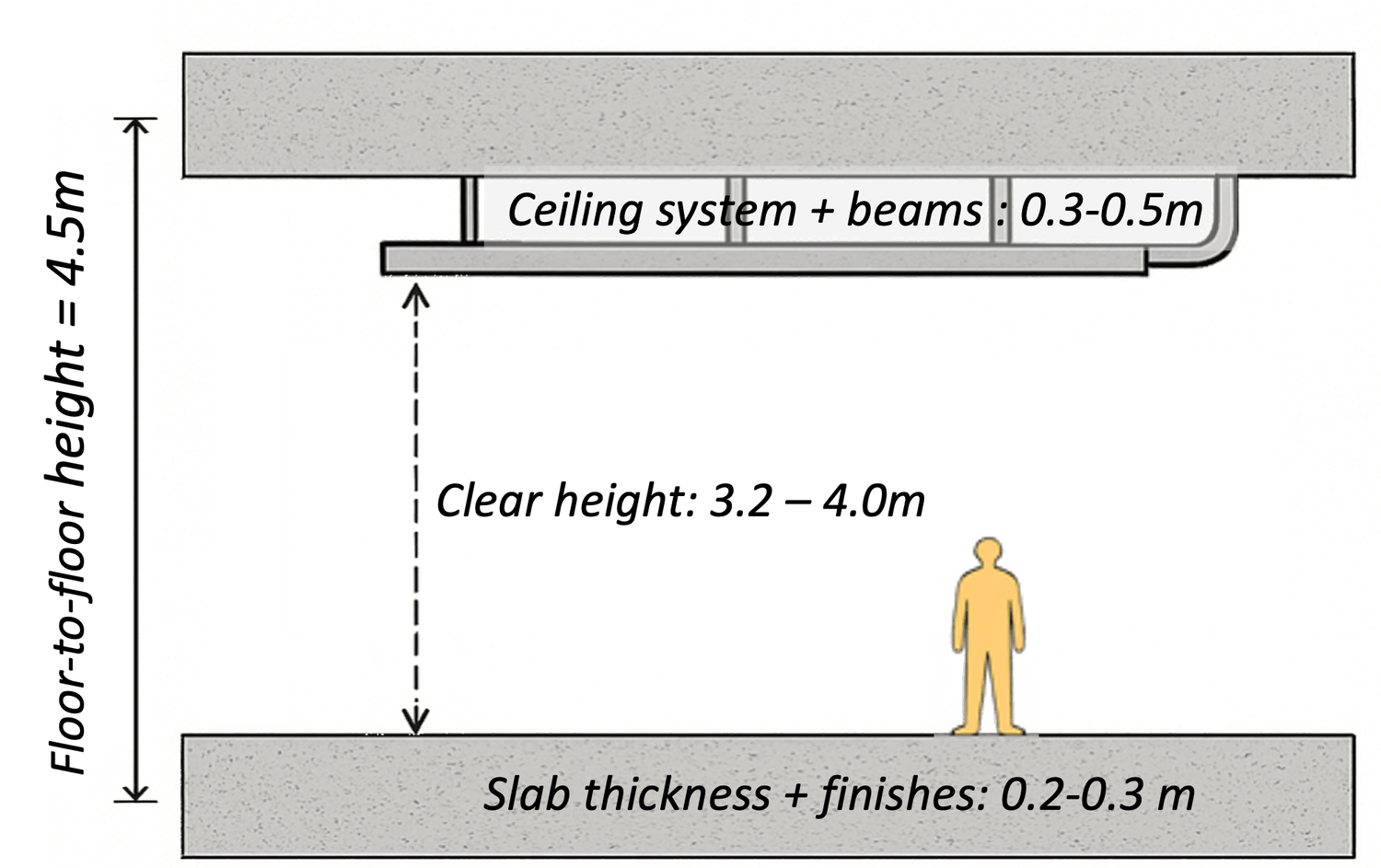
Clear height is the usable internal height from finished floor to the lowest obstruction (e.g. beam, sprinkler) and it is always lower than the “headline” floor‑to‑floor height.
In a typical industrial building, you first lose about 0.2–0.3 m between floor‑to‑floor and floor‑to‑ceiling for slab thickness, floor finishes and any ceiling system, then another 0.3–0.5 m for downstand beams and overhead services, so clear height can be 0.5–0.8 m less than the floor‑to‑floor figure you see in brochures
Floor Loading: How Much Weight Your Floor Can Take
Floor loading (often shown in kN/m²) tells you the maximum uniformly distributed load the floor can safely support.
Industrial and warehouse floors in Singapore commonly specify capacities such as 20–30 kN/m² on ground floors and 15–20 kN/m² on upper ramp-up floors.
Technical guides note that industrial slabs must be designed to carry static loads (racks, stacked pallets, machinery) and dynamic loads (forklifts, reach trucks) without cracking or excessive deformation.
If you are installing heavy equipment, dense racking or block stacking, check both the floor loading and any point load limits; exceeding them can cause structural and safety issues and may breach JTC/BCA approvals.
DB Box, Electricity and Power Capacity
“DB box” typically refers to the unit’s distribution board, where circuits and power supply are controlled.
JTC’s statutory controls highlight that any upgrading of electrical load requires proper submissions and approval from SP Services and relevant authorities, especially if you need higher power than what is provisioned.
For many B1/B2 units, incoming power can range from single‑phase supply for office/light use to substantial 3‑phase loads for production and cold rooms; the exact amperage matters for heavy machinery or chillers.
Before signing, clarify:
Existing approved electrical load (kVA/Ampere).
Whether the DB can be upgraded, and what lead time and cost SP/JTC have indicated historically for that estate.
A “cheap” unit with insufficient power can quickly become expensive if upgrades require significant time, approvals and additional infrastructure.
Fire Alarm Detection (FAD) And Compliance
Fire Alarm Detection (FAD) systems are critical for safety and regulatory compliance.
JTC’s schedule of statutory controls specifies that additions and alterations involving fire alarm and protection systems require consent from JTC and approvals from the Fire Safety and Shelter Department (FSSD).
For certain trades (for example, storage of flammables, high‑rack storage, or food processing), the fire protection design may need enhancements such as in-rack sprinklers or extra detectors.
When viewing a unit, check what FAD system is installed, whether it meets your intended use, and whether further works will be required to get fire safety approval.
Mezzanines: Extra Space With Structural And Regulatory Limits
Mezzanines are intermediate floors within the unit, often used for offices, storage or light production.
BCA’s guide on industrial developments stresses that all mezzanine structures must comply with structural, fire safety and planning requirements; “unauthorised” lightweight platforms can lead to enforcement action.
Any addition of mezzanine area typically counts towards gross floor area and may require JTC consent and URA/BCA approval before construction.
When you see mezzanine potential, factor in:
Whether the existing structure and floor loading can handle extra loads.
Design and approval costs, not just construction cost.
Vehicular Access: 20‑Footer, 40‑Footer And 24‑Foot Lorry
Good vehicular access is critical for logistics and many manufacturing trades.
Modern ramp-up warehouses in Singapore are often marketed as “40‑footer accessible”, with wide ramps, turning radii and loading bays designed to handle full container trailers.
Smaller vehicles such as 20‑foot container trucks and 24‑foot lorries generally require less space to turn and manoeuvre.
A common question from owners is: “How do I know it can clear a 20‑footer?”
BCA and LTA design guidelines focus on the worst‑case design vehicle, which, for industrial uses, is typically the 40‑foot trailer, not the 20‑footer.
There is no separate BCA requirement to declare “20‑footer clearance” in submissions; compliance is demonstrated for the largest relevant vehicle class. If a building is designed and approved for 40‑footers, smaller trucks (20‑footers, 24‑foot lorries) will naturally be able to manoeuvre.
Where a site is not designed for 40‑footers (for example, flatted factories with only cargo lifts), plans and tenancy documents typically focus on vehicle height/weight limits, not a specific 20‑footer declaration.
In short, 20‑footer clearance is not individually called out because it is not a standalone regulatory requirement; design checks are done for the largest vehicle type instead.
Putting It All Together Before You Commit
To avoid expensive surprises:
Check clear height and floor loading against your racking and machinery plans.
Confirm DB box and power capacity can support your equipment, or that upgrades are realistic.
Ensure FAD and fire protection can be brought up to spec for your trade without major redesign.
Treat mezzanines as a regulated structural element, not a DIY add‑on.
Match vehicular access to your actual vehicle mix and shipment volume.
An industrial unit that is slightly more expensive on paper but has the right specifications will often be cheaper and more productive over its full lease tenure.
https://www.jtc.gov.sg/-/media/project/jtc-cx/corpweb/assets/get-help/schedule-of-statutory-controls-for-flatted_ramp-up-and-stack-up-factories.pdf
https://www.jtc.gov.sg/-/media/project/jtc-cx/corpweb/assets/get-help/schedule-of-statutory-controls-for-land_standard-factory-and-workshop-customers.pdf
https://www1.bca.gov.sg/docs/default-source/docs-corp-news-and-publications/publications/for-industry/guide_on_construction_of_industrial_developments_in_singapore.pdf
Back to Insights here

ABOUT US
Helping Singapore business owners and investors quickly find practical, well‑located industrial spaces for their own use or investment.
You share your budget and requirements, and we handle the legwork—from shortlisting units and arranging viewings to negotiating terms and coordinating paperwork—so the whole process stays simple and stress‑free for you.
Copyrights @ 2025 All Rights Reserved. | Privacy Policy