20ft vs 40ft Ramp-Up
A ramp-up industrial unit is a factory or warehouse where vehicles can drive directly to the unit’s floor via a vehicular ramp, instead of unloading at a common ground-floor dock and using cargo lifts.
JTC’s statutory controls distinguish ramp-up and flatted factories, and require ramps, driveways and loading areas to comply with industrial design and safety standards.
Proper ramp-up design allows trucks and lorries to park right outside your roller shutter, which shortens material-handling distances and removes lift bottlenecks.
For logistics, e‑commerce and high-throughput industrial users, direct ramp-up access is often a key productivity driver rather than just a “nice-to-have” feature.
Key Dimensions: Height Clearance, Turning Radius, Ramp Width
When you look at ramp-up projects, three dimensions matter most: height clearance, turning radius / manoeuvring space, and ramp / driveway width.
Height clearance
The vertical clearance along ramps and at loading areas must exceed the height of the largest vehicles using them, including any allowances for suspension movement and overhead services.
Industrial ramp design guides emphasise that insufficient headroom near beams, sprinklers or ducts can turn a “40‑footer capable” ramp on paper into a practical constraint on site.
If you expect taller box trucks or container trailers, always confirm the clear height at the tightest point, not just the nominal floor-to-soffit height.
Turning radius and manoeuvring space
Longer vehicles need bigger turning radii and more space to swing into ramps and bays. International industrial ramp design references give a good sense of the difference between 40‑foot and 20‑foot trucks:
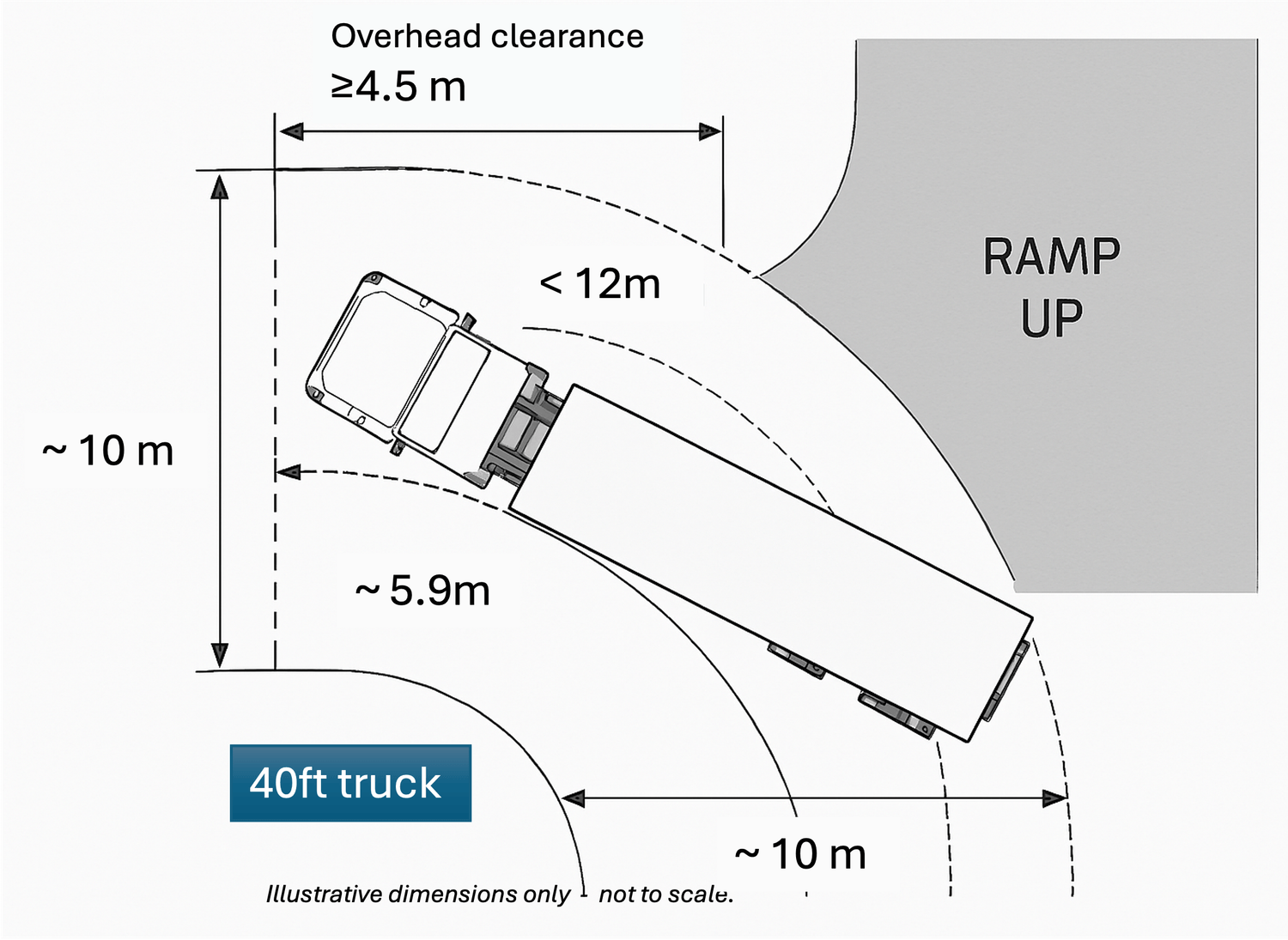
A typical 40‑foot truck can require:
An approach depth of around 12 m.
A ramp width of about 10 m.
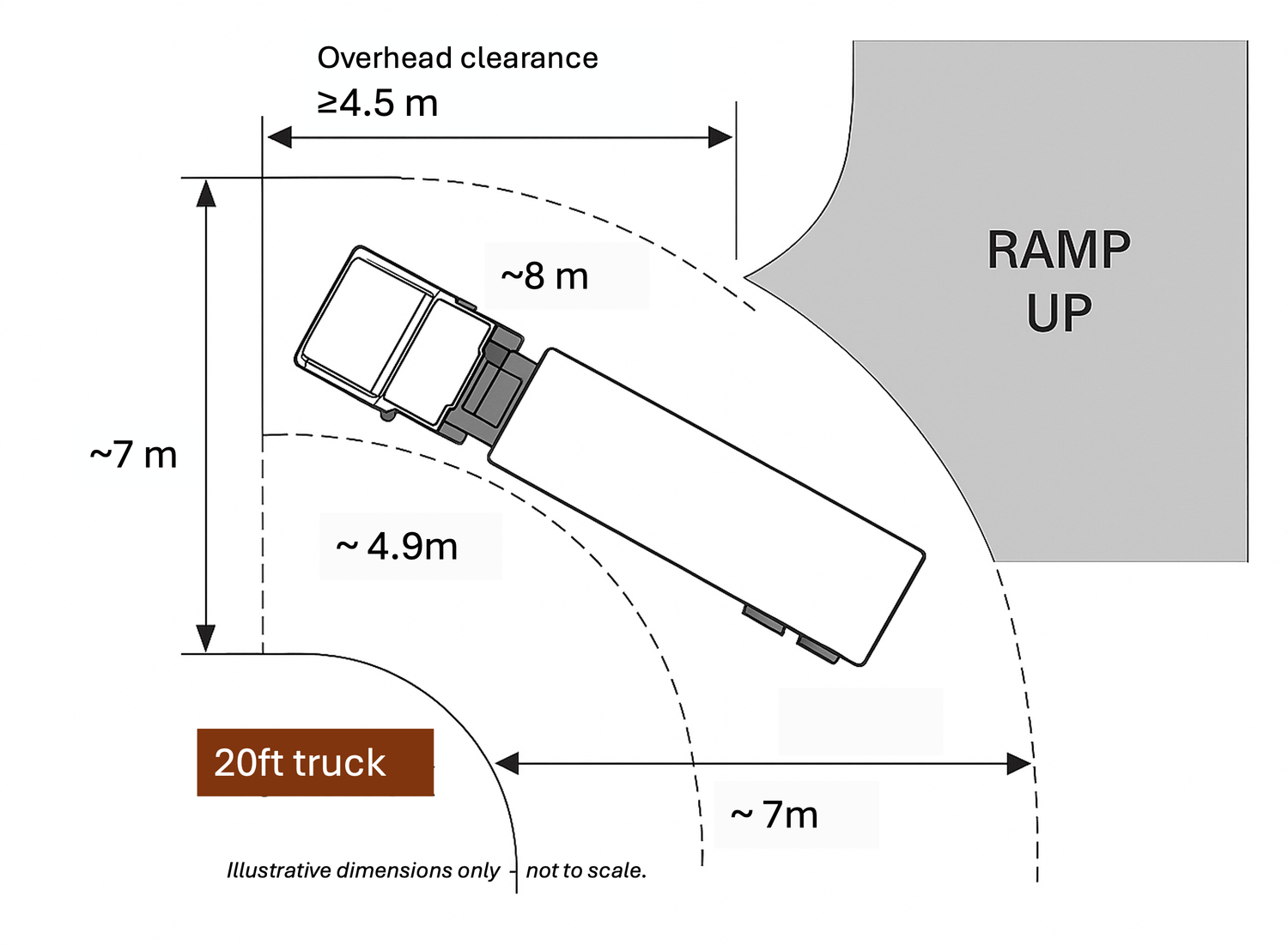
A 20‑foot truck, being shorter, can work with:
A turning radius of roughly 8 m.
A ramp width of about 7-8 m.
The exact numbers vary by vehicle and design, but the principle is clear: 40‑footers need materially more manoeuvring room than 20‑footers, especially at tight ramp corners and landings.
Ramp and driveway width
Ramp and driveway width must safely accommodate the truck plus lateral clearance on both sides.
Industrial ramp guides recommend generous widths so that trucks can keep clear of edge protection and structural elements, and, where required, allow safe two-way traffic.
JTC’s specifications for ramp-up factories also reference minimum carriageway widths and require owners to obtain consent before altering ramps or traffic circulation.
If the ramp is too narrow, larger trucks may technically be able to pass but will need repeated shunting, which slows operations and increases risk.
So...Is It Worth Paying For 40-Footer Ramp Access?
Designing a building to handle 40‑foot container trucks all the way up the ramp is expensive in Singapore’s land-scarce context.
A 40‑footer‑capable ramp system needs more land for turning radii, wider carriageways and more generous landings, which eats into net lettable area and pushes up cost per square metre.
Because of this, many developments highlight “40‑footer access” as a key differentiator, especially for logistics and heavy distribution users.
Whether it is worth paying for depends on how you actually operate:
If 40‑footers are part of your daily operations or you expect them soon:
Paying a premium for true 40‑footer ramp access is often justified. It reduces double‑handling at ground level, cuts loading times and makes your unit more attractive to future logistics‑heavy tenants or buyers.
Over a 10–15 year horizon, these operational savings and stronger leasing appeal can outweigh having a slightly smaller unit because of land taken up by the ramp.
If you mainly use 20‑foot trucks or 24‑foot lorries, with only occasional 40‑footer use:
A 40‑footer‑ready ramp still carries “option value” – you can handle peak events, larger shipments or a future change in business model without relocating.
However, if 40‑footers are genuinely rare and unlikely to become routine, you may be better off prioritising a larger or better-shaped unit in a development optimised for smaller vehicles.
If your trade is light industrial or office‑heavy with minimal truck movement:
You are unlikely to fully benefit from the extra land and design cost embedded in a 40‑footer ramp.
In this case, focus on specs like power, floor loading, layout efficiency and location; a simpler flatted or light‑truck‑only ramp-up building may offer better value.
A useful rule of thumb: if choosing a 40‑footer‑capable ramp-up building means noticeably less floor area for the same budget, make sure the savings in handling time, future flexibility and eventual exit value are meaningful for your specific trade. For some logistics users, the answer is clearly “yes”; for light users, a well-designed 20‑footer‑friendly scheme can be the smarter choice.
Sources:
https://www.jtc.gov.sg/get-help/managing-your-tenancy-or-lease/tenancy-and-lease-forms-and-documents
https://www.afm.com.sg/jtc-policy-Site-Usage-update/usage-guidelines-for-jtc-premises
https://www.jtc.gov.sg/-/media/project/jtc-cx/corpweb/assets/find-space/documents/e-bidding/development-specification/ysone-s.pdf
https://sgp.sika.com/en/knowledge-hub/how-to-design-floor-for-warehouse-and-logistics-facilities.html
https://pja.com.au/standardised-speed-distributions-turning-radii/
Back to Insights here

ABOUT US
Helping Singapore business owners and investors quickly find practical, well‑located industrial spaces for their own use or investment.
You share your budget and requirements, and we handle the legwork—from shortlisting units and arranging viewings to negotiating terms and coordinating paperwork—so the whole process stays simple and stress‑free for you.
Copyrights @ 2025 All Rights Reserved. | Privacy Policy